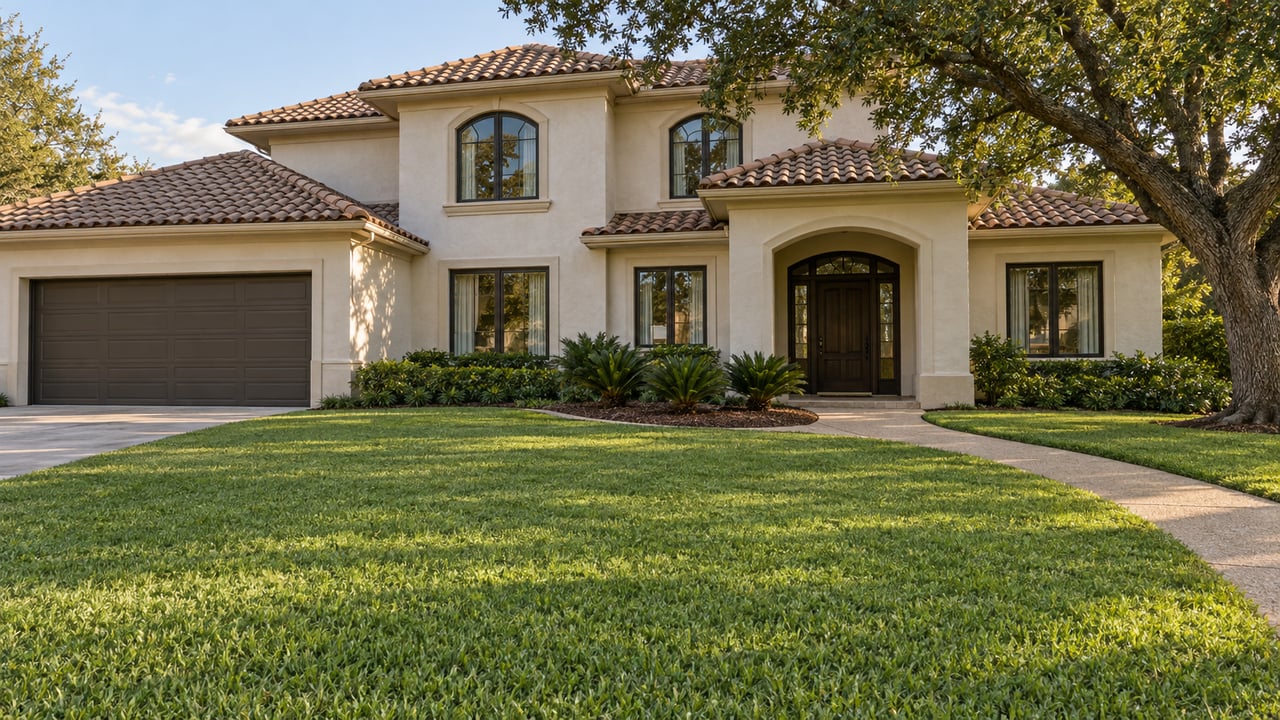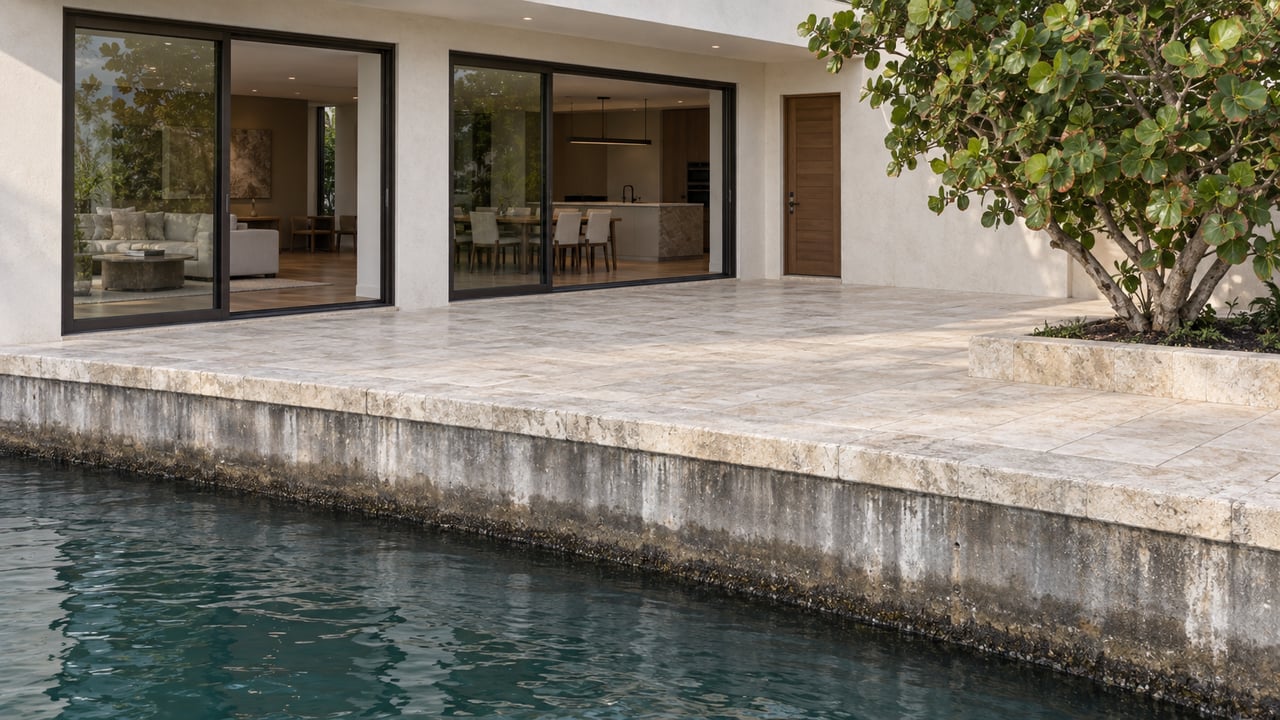
What does a Boynton Beach listing actually mean when it says "waterfront"? The word covers two systems that behave nothing alike once you own them. One is a freshwater canal that dead-ends into Lake Ida or Lake Osborne, calm, landlocked, with no real tide to speak of. The other ties directly into the Intracoastal Waterway and runs out through the Boynton Inlet to open ocean, tidal twice a day, carrying boat wake and salt exposure every week of the year. Both get marketed as waterfront. Both carry a premium over an inland home with the same square footage. Only one of them comes with a materially higher chance that the wall holding your yard in place needs real money spent on it inside the next decade.
The seawall's condition and potential repair costs may become clear during an inspection, often after an offer is signed.
Freshwater and Saltwater Aren't the Same Purchase
A canal home in a neighborhood like Leisureville, sitting on a freshwater system that feeds Lake Ida and Lake Osborne, faces a different physical environment than a home on a saltwater cut in Golfview Harbour that opens straight to the Intracoastal. The freshwater side skips the daily tidal cycle and the corrosive chemistry that comes with salt. The saltwater side gets full access to the ocean through the Boynton Inlet, which is exactly why marinas like Boynton Harbor Marina and Two Georges Marina, along with public ramps at Harvey E. Oyer Jr. Park and Boat Club Park, cluster near that stretch of water instead of the inland lakes.
That access is worth something. It's also why the Boynton Inlet and its connected canals require regular dredging and structural upkeep that a Lake Ida canal simply doesn't face at the same rate. A buyer comparing two "waterfront" listings side by side is often comparing a low-maintenance freshwater amenity against a higher-maintenance saltwater one, and the listing photos look identical.
What a Seawall Actually Costs in Palm Beach County
The number that turns this from a curiosity into a financial question is the cost of the wall itself. In Palm Beach and Broward County, seawall repair runs anywhere from $2,000 for sealing a hairline crack up to $80,000 or more for a full replacement, based on 2026 pricing from JKT Marine, a marine contractor working both counties. A repair, when the wall still has structural integrity, typically costs 15 to 40 percent of a full replacement. Most 30 to 40 year old walls in protected canals still fall into that repairable category if the damage is caught early.
The trouble is what happens when it isn't. A minor crack can turn into a $5,000 to $15,000 structural repair within two to three years if it's left alone, and from there it keeps compounding until repair is no longer an option and the homeowner is looking at full replacement pricing. A listing sheet may not make the wall's condition clear. A marine engineer walking the property can assess it.
That's not a small distinction for a saltwater canal home versus a freshwater one. Saltwater accelerates the corrosion that eventually creates that crack in the first place. A wall on a tidal, saltwater cut off the Intracoastal is working against a harsher environment than a wall on a landlocked freshwater canal, even if both walls are the same age and the same material.
The Permitting Clock Attached to Every Wall
Cost isn't the only variable that splits along the freshwater and saltwater line. Permitting does too. Standard residential processing runs 4 to 10 weeks. JKT Marine says state environmental review through the Florida Department of Environmental Protection is often handled concurrently with county permitting. Army Corps of Engineers review gets added on top when the work sits near seagrass, mangroves, or other environmentally sensitive habitat, and that trigger is far more common on Intracoastal and ocean-access properties than on the inland lake canals.
In plain terms, a seawall repair on a Lake Osborne canal home is likely to clear permitting faster than the identical repair on an Intracoastal-adjacent home near the Boynton Inlet, simply because of what's growing in the water nearby. If a buyer is timing a purchase around getting repair work done before hurricane season or before a rental season starts, that permitting difference is a real scheduling risk, not a footnote.
Putting Seawall Costs in the Context of Boynton Beach Price Cuts
Boynton Beach's broader market gives some useful context for how this plays out at the negotiating table. As of the September 15, 2026 market snapshot, the median single-family house in the city sold for $567,500 in August 2026, up 11.3 percent from a year earlier, while condos and townhouses closed at a median of $285,000. Inventory sat at 426 houses for sale against 2.9 months of supply at that pace, a market that still leans toward sellers but isn't running away from buyers either.
Inside that same snapshot, 49.3 percent of houses for sale were sitting at an asking price below where they started, with a median recorded cut of $30,000. That figure lands almost squarely in the middle of what a partial seawall repair costs in this market, above the low end of crack sealing and well below a full replacement. It doesn't prove every price cut in the city is a seawall renegotiation. It does suggest that when a buyer's inspector flags a wall in decline, a five-figure adjustment to the asking price is a common and reasonable outcome, not an outlier.
For a buyer comparing a canal-front asking price against the citywide house median, that $30,000 gap is worth treating as a baseline expectation rather than a surprise if the seawall report comes back anything less than clean.
Reading a Waterfront Listing Like an Engineer Would
None of this argues against buying waterfront in Boynton Beach. It argues for asking a more specific set of questions before the inspection period runs out. Which water body does the canal actually connect to, Lake Ida, Lake Osborne, or the Intracoastal through the Boynton Inlet? What material is the seawall, concrete, vinyl, or something else, and how old is it? Has it ever been repaired, and if so, what triggered that repair? Is there a recent engineering assessment on file, similar to the kind of inspection work firms like Terragone Engineering perform across hundreds of Florida seawall projects, or is the seller relying on visual condition alone?
A buyer who asks these questions before writing an offer is negotiating from the same information the seller's own contractor would use. A buyer who asks them after closing is negotiating with no leverage at all, just a bill.
A few questions worth asking before you write an offer:
Does a freshwater canal home need the same permits as a saltwater one? The added layer, Army Corps review for seagrass or mangrove habitat, shows up far more often on Intracoastal and ocean-access properties than on canals feeding Lake Ida or Lake Osborne.
Who typically pays for a seawall repair when one is found during inspection? It's negotiated case by case. A documented repair need is one of the more common items that shows up as a price adjustment or seller credit in Palm Beach County waterfront transactions.
Is dredging a homeowner cost or a public one? The Boynton Inlet and its connected canals require regular dredging and structural maintenance as a matter of course. Whether a specific canal segment falls under public maintenance or a private assessment depends on the waterway, and it's worth confirming for any canal that hasn't been dredged recently.
If you're weighing a canal-front listing near Two Georges Marina against a quieter parcel backing up to Lake Ida, the house is the easy part to evaluate. The wall is the part that needs someone who knows which questions Boynton Beach actually answers differently depending on which water you're buying into. Reach out to Erik Ginsberg and let's get the seawall looked at before you fall for the view.
This article is general information, not legal, tax or financial advice. Consult a qualified professional about your situation.